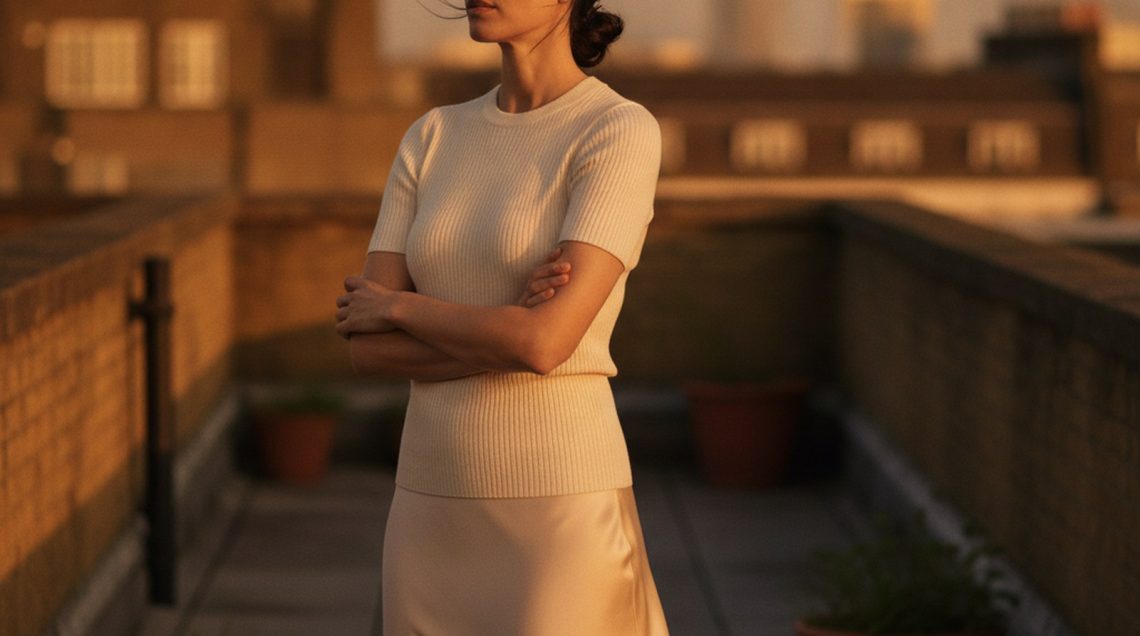
If you have ever stood in a Cotswolds garden in late June, sweating through a linen shirt at 2pm and shivering in it by 7, you already know the British summer has a fabric problem. The answer is not another linen shirt or a cardigan stuffed into a tote. It is a single fine-knit cotton or silk-blend piece, built into your capsule as the anchor, not the afterthought.
This is the fortnight that proves the case. Royal Ascot, Wimbledon queues, three weddings in a row, a Glastonbury hangover and a rooftop work drink, all in temperatures that swing from 14 to 22°C with a 40 percent chance of drizzle. You cannot dress for that with woven linen alone. You can dress for it with one clever knit.
Why linen fails the British summer specifically
Linen is not a bad fabric. It is a fabric built for a different climate. Its flax fibres are hollow and the weave is open, which is brilliant at dumping body heat in 30°C Mediterranean humidity. At a UK average of 18 to 22°C, that heat-dump turns into a liability. The sun goes behind a cloud, the breeze picks up off the Thames, and you go cold within minutes.
Then there is the wrinkle problem, which is really a fibre-mechanics problem. Flax fibres are flat, rigid and have low elasticity, so once they fold under the strap of a bag or against the back of a wicker chair, they hold that crease. By the time you are at the champagne tent, your shirt looks like it has been slept in. A knit construction behaves entirely differently: the loop structure has inherent give, so it compresses and recovers rather than creasing. You sit through a long lunch, you stand up, the knit springs back. No steam required. That alone is worth the swap on a June morning when you are running for the 8.12 to Waterloo.
The fabric science, briefly
A fine-gauge cotton knit traps a thin, breathable layer of warmth between the loops without overheating in mild sun. That thermal buffer is exactly what 18 to 22°C asks for. Add a silk blend (cotton-silk knits sit around 70/30) and you get a subtle sheen that reads occasion in evening light, plus marginally better drape.
The benchmark is John Smedley’s Sea Island cotton, a long-staple fibre knitted to a fine gauge that breathes like a shirt but recovers like jersey. It is the gold standard for a reason: it does not pill quickly, it does not crease, and it works at 16°C and 23°C without complaint. If Smedley is the heritage option, Arket’s compact cotton rib tops are the high-street equivalent, and Sézane’s cotton-silk fine knits are where you go for the evening upgrade.
The one-piece, three-jobs rule
A UK-focused summer outfit ideas TikTok that illustrates real-wear styling choices relevant to the fine knitwear vs. linen debate for British summer dressing.
@aysatlife Replying to @Wille Let me know if you want more of these 🥰 Body balm @ayodiskin (ZEE Best!!🥰) Top @superdry Trousers @RESERVED Belt @TOTEME Earrings @_initialled Sunnies @Miu Miu Bag @LOEWE #causeeverybodyhasthatright #ukfashion #ukstyle #summeroutfit
This is what makes a fine knit a capsule anchor rather than just a nice top. One piece, three registers in a single day:
- Day: fine-knit shell top tucked into a midi skirt or wide-leg trouser. Lunch in Marylebone, a wander round Chelsea, the train down to Ascot.
- Early evening: same top, fine-knit cardigan draped over the shoulders or knotted at the collarbone. Reads pulled-together, not fussy.
- Cool morning or late terrace: cardigan buttoned over a silk camisole, sleeves pushed to the elbow. Done.
That is one fabric family replacing three single-use items: the linen shirt, the light jacket, the evening layer. Your tote stays empty. Your shoulders stay warm. Your outfit stays coherent from 9am to 9pm.
Want more wardrobe logic like this, the kind that explains why a piece works rather than just what to buy? Join the Mūsmūs newsletter for one considered email a week: capsule edits built for British weather, honest fabric verdicts and outfit formulas you can actually wear from a 9am train to an 8pm garden. No noise, just the good stuff.
Making a fine knit read summer, not autumn
The reason fine knits sometimes look wrong in June is proportion, not fabric. Three rules fix it.
- Pair with volume below. A high-waisted wide-leg trouser in linen or cotton poplin, or a full cotton midi skirt. The volume contrast stops the knit reading autumnal. A slim knit over slim trousers is where things tip into October.
- Keep the hem cropped or hip-length. Thigh-length fine knits skew jumper-dress, which is the wrong season. A shell top that hits at the high hip, tucked, is the cleanest line.
- Choose open construction. Pointelle (the little open-stitch pattern M&S does well in cotton), a loose rib, or a sheer silk-blend polo like the ones COS does. The eye reads skin through the stitch and the brain registers summer.
This is the formula a lot of women in their late twenties and thirties have quietly adopted: a fine knit tucked into something tailored, sleeves a little pushed up, a flat sandal or a slingback. Daisy Edgar-Jones wears it consistently off duty, knit tops tucked into wide trousers, and it is the reason the look feels current rather than mumsy. It is also, not coincidentally, the easiest formula to repeat.
The British high-street edit
You do not need a deep bench. You need two or three pieces in the right fibres.
- John Smedley: the Sea Island cotton crewneck or short-sleeve polo. Buy once, wear for a decade. The cream and the black are the workhorses.
- Arket: compact cotton rib tops in vest, short-sleeve and long-sleeve. Under £50, surprisingly heavy-duty.
- M&S: pointelle cotton knits in their main womenswear line, often under £30. The open stitch does all the summer-signalling work for you.
- Uniqlo: the cotton ribbed cardigan and the short-sleeve cotton polo, both reliable, both cheap enough to own in two colours.
- COS: a sheer silk-blend polo knit for evening, worn with tailored shorts or a column skirt.
- Sézane: cotton-silk blend knits with that subtle sheen, the right answer for a Cotswolds wedding when the dress code says smart but the forecast says 17°C.
- & Daughter: the Irish cotton crewneck, knotted over a slip dress for the walk back from dinner.
Mary Quant put women in knit shorts and fine-gauge tops in the 1960s for precisely this reason: British weather rewards a fabric that moves with the body and the day. London creatives like Abisola Omole still build summer looks around fine-knit co-ords for the same logic. The argument is not new. It just keeps getting drowned out by linen marketing.
One action this week
Before the weekend, audit your top drawer for one fine-gauge cotton or cotton-silk knit in a neutral (cream, black, navy or a soft stone). If you do not own one, the Arket compact rib short-sleeve under £45 is the lowest-risk entry; the John Smedley Sea Island crewneck is the investment that will outlast three linen shirts. Wear it tucked into your widest trousers on the next 20°C day and notice what you do not need to carry. That is the capsule working.