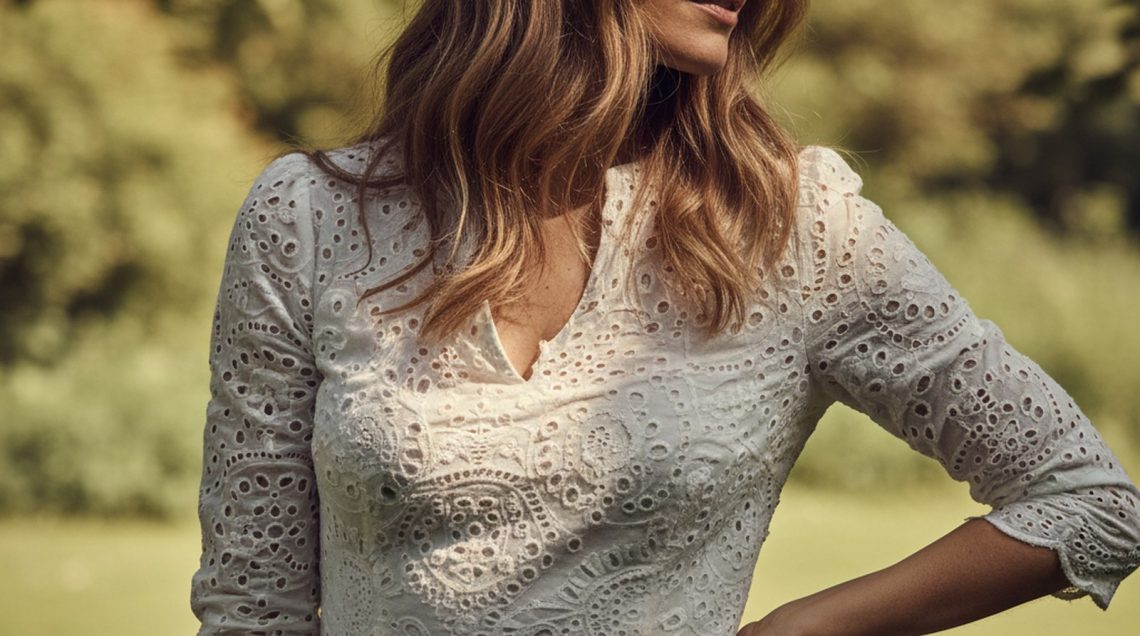
Broderie anglaise looks identical on a hanger at M&S, Arket, Boden, H&M and Zara, but the gap between a piece that survives ten summers and one that puckers after a single wash is enormous, and it shows up the moment British weather gets involved. If you have bought a dress for Ascot, a June wedding or a half-term garden lunch, the quality cues are visible in the shop, and the care rules are stricter than the label suggests. Here is what actually matters, in the order it matters.
The in-shop quality test (do this before you pay)
Broderie anglaise is defined by its eyelets, so start there. Hold the fabric up to a shop light and look at the inside edge of each hole. On a well-made piece, every eyelet is ringed in tight buttonhole or satin stitch with no stray threads; on a fast-fashion version, you will see frayed cotton or a thin zigzag, often the giveaway of laser-cut holes that have been heat-sealed rather than properly bound. Laser-cut eyelets feel slightly plasticky to the fingertip. Stitched eyelets, traditionally produced on a Schiffli embroidery machine, feel raised and clean.
Now the base fabric. Rub a section between thumb and forefinger. Cotton lawn or cotton batiste feels cool, papery in a crisp way, and drapes when you let it fall. Polycotton feels slightly warm, faintly waxy, and holds an artificial body. If the swing tag does not specify 100% cotton, assume there is polyester in there.
Three more things in thirty seconds: turn the dress inside out and look at the seams (French seams or bound seams signal a piece built to last; raw overlocked edges will fray straight through the eyelets within a season); check the care label for the words “pre-shrunk” or “sanforised” (their absence means budget up to 10% shrinkage on first wash); and most importantly, check the lining.
The polyester lining trap
This is the single biggest mistake in high street broderie. A 100% cotton broderie shell lined in polyester satin or poly crepe traps body heat and moisture against your skin, which is the exact opposite of what cotton is meant to do. You will spend a garden party damp, the dress will cling, and the eyelets that are supposed to ventilate become decorative only.
The lining hierarchy, from a wearability standpoint:
- Cotton voile or cotton mull: ideal. Breathes with the shell, soft against skin, washes with the dress.
- Cupro or viscose: acceptable. Cool to the touch, drapes well, less breathable than cotton but won’t trap heat.
- Polyester satin or poly crepe: avoid. Recognisable by its slippery, cold-then-clammy feel and unmistakable sheen.
Arket and COS tend to use cotton or cupro linings on their broderie pieces; M&S varies by line (the Autograph end of the range usually does cotton, the cheaper tiers default to poly); Boden is generally cotton-lined on its summer cotton dresses. Self-Portrait, Kitri, Damson Madder, Ganni and Sézane sit in the cupro/viscose camp at the designer end. At the fast end, Zara and H&M’s broderie is overwhelmingly polycotton with poly lining, which is fine for a one-event dress and a disappointment for anything else.
How it actually behaves in a British summer
Cotton is hygroscopic, meaning it absorbs atmospheric moisture as well as sweat. In British conditions (16-19°C, 70%+ humidity, light drizzle that arrives without warning), an unlined or thinly lined broderie dress can go subtly transparent and start clinging after two to three hours outdoors. This is why the lining conversation matters more here than it does in drier climates where fashion magazines tend to write from.
Light rain is the second test. Water beads differently around the eyelet holes than across plain cotton, so on a quality piece with tightly bound eyelets the embroidery stays crisp as it dries. On a cheaper version, water wicks into the unfinished stitching and the embroidery outline warps as it dries, leaving a slightly stiffened, puckered halo around each hole that no iron will fix.
The fix for the transparency problem is a built-in slip in cotton voile or a high-cut cotton half-slip worn underneath. A separate full underskirt creates bulk under a lightweight dress and ruins the line. Catherine, Princess of Wales has worn broderie anglaise to several outdoor summer engagements, and the reason those pieces read as polished rather than picnic-y is almost always a properly proportioned, opaque underlayer in a matching tone, plus a fabric with enough body to skim rather than cling.
Want more honest fabric reads like this one, straight to your inbox? Mūsmūs sends one weekly edit on what to buy, what to skip and how to make the good pieces last, written for women who would rather own four dresses that work than fourteen that don’t. Sign up at the top of the page and you’ll get our broderie shopping checklist as a downloadable next week.
Washing it without wrecking it
The standard advice (cool wash, gentle cycle, line dry) is correct but incomplete. Three rules nobody writes down:
Skip fabric softener entirely. It coats the cotton fibres and clogs the embroidered texture, reducing the breathability the eyelets exist to provide. Within three washes you can see the difference: softener-treated broderie sits flat and dull where untreated broderie keeps its slight raised dimension.
Wash coloured broderie cold and alone the first time. The 2026 trend is bold-colour broderie (think raspberry, cobalt, butter yellow, often from Damson Madder, Farm Rio, Isabel Marant Étoile, Juliet Dunn, Loretta Caponi at the top end, Dôen and Reformation in the middle), and synthetic embroidery thread on a cotton base bleeds. Use a colour-catcher sheet for the first three washes. Melissa Odabash and Self-Portrait pieces with coloured thread are particularly worth this caution.
Plan for shrinkage on anything not labelled pre-shrunk. Up to 10% on the first wash for unfinished cotton broderie is realistic. If the dress fits well in the changing room and there is no pre-shrunk claim, size up, or hand-wash cold for the first cycle to minimise the contraction.
Ironing and the terry-cloth trick
Every guide says iron on the wrong side. That works on plain cotton; on broderie it can still flatten the embossed eyelet texture against the board. Better method: lay a thick clean terry towel on the board, place the dress face down on the towel, and press through the wrong side at a medium dry heat. The eyelets sink into the pile of the towel instead of being crushed against a hard surface, and the raised dimension survives. Avoid the steam function directly on the embroidery; steam from a distance, then press.
Storing it so it lasts beyond one event
The two ways broderie anglaise gets ruined post-event are folding and plastic. Sharp folds along the embroidery permanently crush the raised texture; plastic garment bags trap residual moisture and, on white broderie, cause yellowing along the fold creases over a single warm summer in a wardrobe.
Hang the dress on a padded hanger inside a cotton or linen garment bag, or if you must store it flat, roll it loosely around a tube of acid-free tissue and keep it in a cotton pillowcase. Never store white broderie in the plastic bag it shipped in. If yellowing has already started, a soak in cool water with a tablespoon of oxygen-based whitener (not chlorine bleach, which destroys cotton fibres and dissolves embroidery thread) will usually lift it.
The honest summary
A well-made broderie anglaise dress is one of the few summer pieces that genuinely earns its place across years of Ascot, weddings and Chelsea-adjacent garden afternoons. The version that fails is almost always the one with a polyester lining, laser-cut eyelets and no pre-shrunk claim, bought for one event and washed without thought afterwards. Before the next wear, check your lining label; if it says polyester, plan to wear a cotton voile slip underneath and accept the dress for what it is. If it says cotton or cupro, you have a piece worth caring for properly, and the terry-towel iron will keep it looking new through a decade of British summers.