Organza has a reputation problem. It reads as stiff, fussy, the fabric of christening gowns and bridesmaids who didn’t get a vote. In fact, for a British summer occasion (a 26°C muggy afternoon at Ascot, a humid garden wedding, a sticky evening at Glyndebourne), organza is one of the most practical fabrics you can wear: it holds its own shape without a petticoat, it doesn’t cling to damp skin, and a silk version will outlast five polyester ones. The catch is that almost every dress on the high street labelled “organza” is polyester, and the care logic for the two is completely different.
This is the guide I wish I’d had the first time I bought an organza dress for Ascot, panicked about creases the morning of, and discovered too late that my iron was the wrong tool entirely. With the Royal Meeting opening on 17 June, here’s how to buy organza properly, how to tell silk from synthetic in the shop, and how to keep the dress alive between June and the September weddings.
Why silk organza is the smarter summer fabric
Silk organza is woven from tightly twisted mulberry silk yarns, which is what gives it that papery crispness without any added resin. Because silk is a protein fibre, it actively wicks moisture and regulates temperature, so during the five-hour outdoor stretch of a race day it sits away from the skin and breathes. Polyester organza, by contrast, is a synthetic woven from plastic filaments and finished with a stiffening resin. It traps heat against the body, holds damp, and the resin finish softens and goes limp the moment humidity climbs.
The other quiet advantage of silk: it doesn’t snag the way poly does on a bracelet, a hat pin, or the velcro of a fascinator strap. Polyester organza’s filaments are slipperier and more brittle, so a pull becomes a permanent ladder rather than something you can smooth back into the weave with a fingernail.
If you want a reference point for what good organza should actually feel like in the hand, Simone Rocha’s tissue-weight pieces are the British benchmark; the cloth has weight without stiffness and a softness that polyester simply cannot fake. You don’t need to buy at that level to wear silk organza, but it’s worth feeling the fabric in a department store once so your fingers know what they’re looking for elsewhere.
How to spot silk versus polyester on the high street
Three tests, all of which you can do before paying.
The hand test. Silk organza feels cool and dry. Crumple a section in your fist for five seconds, release it, and watch what happens: silk creases sharply but the creases soften and partially fall out within a minute. Polyester springs back fast but with a plasticky, hollow rebound; you can feel the resin.
The price test. Silk organza runs roughly £25 to £45 a metre at UK fabric merchants. Polyester organza is £3 to £15 a metre. A finished dress in silk organza, properly lined, almost never retails below £400. If the dress you’re holding in Phase Eight, Coast, Karen Millen or Hobbs is under £80, it is polyester. That isn’t necessarily a reason to put it back; it is a reason to know what you’re buying and to read the lining label, which we’ll get to.
The burn test (for the brave, at home). Snip a thread from the seam allowance inside the dress and hold a flame to it over the sink. Silk burns slowly, smells like burnt hair, and leaves a crushable black ash. Polyester melts, beads into a hard shiny lump, and gives off a chemical smell. It’s the most definitive test you can do, and the seam allowance thread is invisible afterwards.
The lining is the hidden performance variable
Royal Ascot’s Royal Enclosure dress code requires sheer fabrics to be fully lined, which is sensible. But the lining fabric is rarely on the swing tag, and it determines whether you’re comfortable or basting in your own dress by 3pm. A polyester organza dress with a polyester satin lining is a heat-trap stacked on a heat-trap. A silk organza dress lined in cotton voile, silk habotai or silk charmeuse is meaningfully cooler.
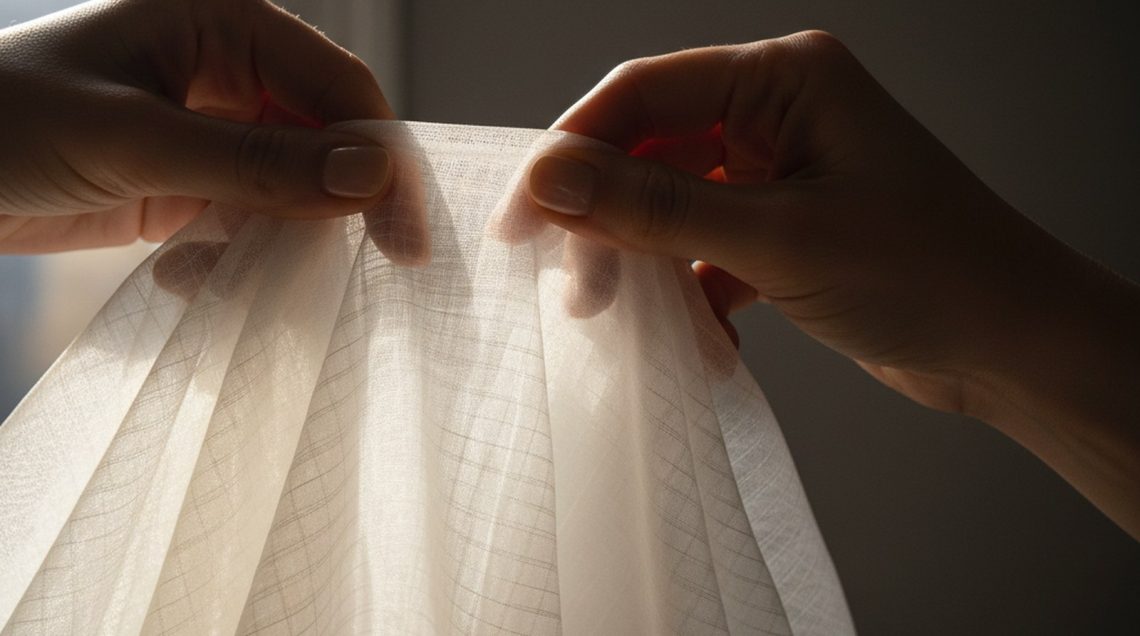
This Pinterest pin showcasing plain black organza fabric up close helps readers visually identify organza’s characteristic sheer, structured weave — key to distinguishing silk from polyester organza when shopping the UK high street.
Favourbrook’s silk organza coats, made in the UK, are a good model of how a quality piece is constructed. On the high street, brands like Self-Portrait, Lalage Beaumont and Susannah London publish their compositions clearly; if a brand doesn’t, the inside seam tape usually does. Check it before you buy.
If you’d like more of this kind of practical wardrobe logic (which fabrics actually work for British weather, how to read a high-street label properly, and what to spend versus what to skip), our weekly Mūsmūs letter lands on Fridays. It’s where we send the styling notes that don’t quite fit into a full article: the small, useful, occasionally contrarian decisions that make a wardrobe behave.
The pre-event creases problem (and why your iron is the wrong tool)
Here is the consumer trap nobody warns you about: polyester organza cannot be ironed at a temperature high enough to release its own creases without risking a melt. You’ll either leave the creases in or you’ll burn a shiny patch into the fabric. The only safe fixes are a handheld steamer held a few inches away (Philips and Tefal both do good UK-available models), or the bathroom steam method.
The bathroom steam method, properly timed: hang the dress on the back of the door, run the shower as hot as it will go, close the door, and leave it for 15 to 20 minutes. Don’t let the fabric touch the wet tiles. Take it out, hang it somewhere airy, and let it dry fully before putting it on, which takes another 20 minutes or so. If you’re trying to leave the house at 9am for an 11.30am gate-open, start the steam at 7.30am.
Silk organza takes a low, dry iron with a pressing cloth between iron and fabric, but honestly the steamer is still safer.
Hand-washing organza at home
Polyester organza, despite the “dry clean only” label most high-street brands stick on it, will survive a 30°C delicate machine cycle inside a mesh laundry bag. The label is largely commercial caution. Silk organza is the one that genuinely needs care.
The method: cool water in a clean sink, a capful of Ecover Delicate or Persil Silk & Wool (both stocked in UK supermarkets), and gentle pressing rather than rubbing or wringing. Soak for no more than five minutes. Rinse twice in cool water, and on the final rinse add a quarter-cup of white vinegar. This neutralises any detergent residue, which is what stiffens silk fibres and makes a washed organza piece feel “wrong” afterwards. Lift the dress out supporting the full weight (wet silk is fragile), lay it flat on a clean towel, roll the towel to absorb water, then hang on a padded hanger out of direct sunlight to finish drying.
Before you wash anything coloured, do a colour-fastness check: dab a damp white cloth on an inside seam. If colour transfers, take it to a dry cleaner instead. Organza’s semi-transparency means any dye bleed shows immediately on the lining.
Stain prevention is easier than stain removal
Organza is unusually vulnerable to oil-based products, and water rings can form on untreated silk. A short pre-event routine saves a lot of panic:
- Apply deodorant the night before, or at least 20 minutes before dressing, and let it dry completely. Organza snags on wet antiperspirant and the white residue shows through.
- Spray perfume on pulse points before the dress goes on, never after.
- Pack a small dry blotting cloth in your bag rather than wet wipes. Water rings on silk organza are harder to remove than the original mark.
- If champagne lands on you, blot, don’t rub, and deal with it properly at home that night.
Storage between June and September
An occasion dress worn at Ascot in June and earmarked for a wedding in September needs a proper between-events protocol. The mistake most people make is hanging it back in the wardrobe and forgetting it. Organza is so lightweight that the brushing of heavier garments will snag filaments over a summer.
Instead: clean it within a week of wearing, even if there are no visible marks (sweat oxidises and sets, and you’ll see yellow at the underarms in September). Fold it loosely with acid-free tissue paper between each layer; the tissue prevents creases from setting hard. Store the folded dress inside a breathable cotton pillowcase or muslin bag, inside a lidded box, somewhere dark and dry. Not the loft (humidity swings), not a plastic zip bag (traps moisture).
One specific action for this week, if you’ve already bought your Ascot dress: cut a thread from an inside seam and do the burn test tonight. You’ll know exactly what you own, and every care decision from here flows from that answer.