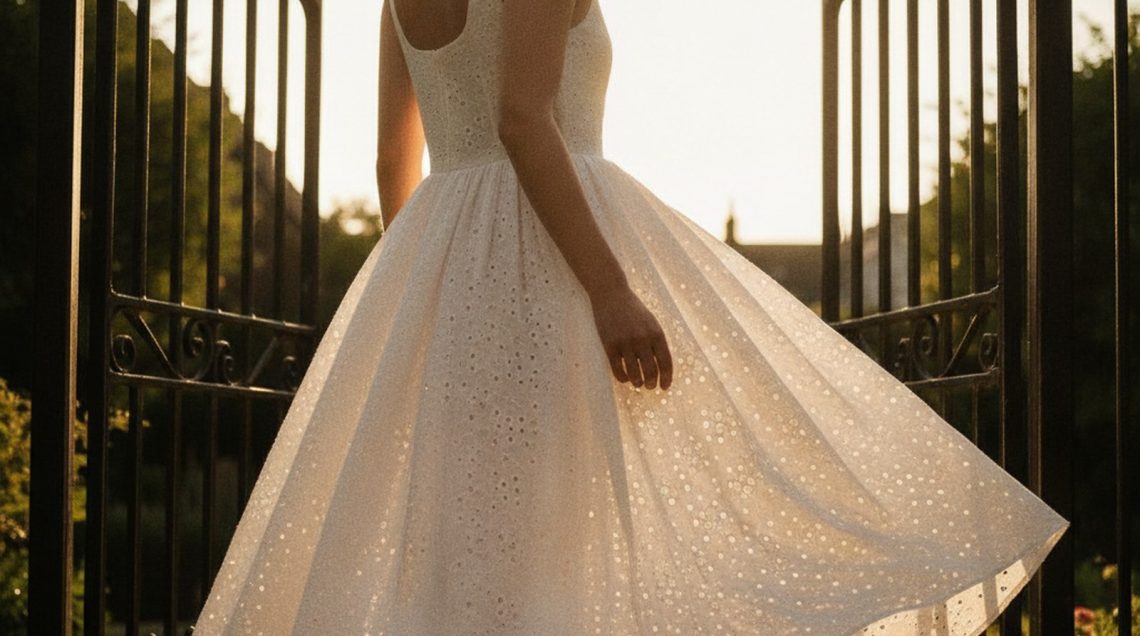
Broderie anglaise care guides treat the fabric as a single thing. It isn’t. A lawn-based broderie from M&S behaves nothing like a heavy cotton-base piece from a fast fashion site, and that difference, not the price tag, decides whether your dress drapes properly, survives thirty washes, and feels wearable at 22°C in a Wimbledon queue. Here is the weight test, the right wash cycle, and the lining check to do before you cut the tags off.
The GSM rule: weight decides drape, not price
Broderie anglaise is an embroidery technique, not a fabric in itself. The embroidery sits on a base cloth, and the base cloth is doing most of the work. There are three weights worth knowing.
- Cotton lawn, roughly 70 to 100gsm. Liberty’s Tana Lawn sits around 76gsm and is the benchmark for fluid, drapey broderie. This is the weight that moves with you, gathers softly at a waistband, and reads polished rather than prim.
- Cotton poplin, roughly 110 to 130gsm. Holds structure. Good for a shirt dress with a defined collar or a tiered skirt that needs a bit of swing without collapse. Slightly less forgiving in heat.
- Heavier cotton or quilting-weight base, 130 to 180gsm and up. This is the tablecloth zone. The embroidery itself adds further stiffness, so a heavy base plus dense cutwork can stand away from the body in a way no styling will fix.
Most UK retailers don’t print GSM on the listing, but Boden, & Other Stories and M&S sometimes describe the cloth as “fine cotton” or “lightweight cotton lawn”, which is your signal it sits at the drapier end. “Pure cotton” with no further description usually means poplin or heavier. If you’re shopping in person, pinch the fabric and let it fall: lawn falls into folds, poplin bends into a curve, heavy cotton holds the shape of your pinch for a second too long.
The starch test before you cut the tags
Cheap broderie anglaise often feels lovely in the shop and falls apart in texture after one wash. The reason is factory sizing, a starch or dressing applied to make the cloth feel crisper and the cutwork look sharper on the hanger. Rub a small section between your fingers for ten seconds. If a faint chalky residue or unusual stiffness comes off, that’s dressing, not quality. The true hand of the fabric only shows after the first wash.
This is why a pre-wash matters. Lamazi Fabrics and other UK dressmaking suppliers flag that broderie can shrink up to ten per cent on first laundry, and the risk is highest with poplin-base pieces that haven’t been pre-shrunk. A cool first wash before wearing protects the waistband and bodice from pulling tight after a summer’s worth of laundering. Yes, this means washing a brand-new dress before you’ve worn it. Do it anyway.
The wash cycle that protects the cutwork
Cutwork embroidery is fragile because the holes are reinforced by thread loops that can distort if the fabric twists hard in a drum. The cycle that works:
- 30°C, delicates or hand-wash cycle, low spin (under 800rpm). Cold isn’t strictly necessary for cotton broderie, but it reduces dye bleed on coloured pieces and limits further shrinkage.
- Mesh laundry bag. Stops the cutwork catching on zips or bra hooks elsewhere in the load.
- A small dose of pH-neutral delicate detergent. Woolite, Ecover Delicate, or any wool and silk wash. Standard biological detergent is too harsh for the embroidery threads over time.
- Skip the fabric softener entirely. This is the step nobody tells you. Softener coats cotton fibres and physically fills the eyelets, which kills the breathability you bought the fabric for in the first place and flattens the raised embroidery. Once softener is in, it’s hard to wash out.
- Air dry flat or on a padded hanger. A tumble dryer’s heat and tumble action is the single fastest way to distort cutwork.
Ironing without crushing the eyelets
Standard ironing advice (low heat, steam) is half right. The missing instruction: iron on the reverse side, over a folded bath towel rather than a flat ironing board. The towel gives the raised embroidery somewhere to sink into, so the iron presses the base cloth flat without crushing the texture of the cutwork. Press, don’t drag. On a viscose broderie (more on that below), use a pressing cloth on top or skip ironing and steam from a distance instead, because direct heat will leave a permanent shine.
This Pinterest pin showcases a cotton broderie anglaise fabric from UK retailer Fabrics Galore, explicitly noting it is washable at 30°, directly reinforcing the article’s fabric weight and care guidance for UK readers.
https://www.pinterest.com/pin/551761391864833603/
Want the rest of our British summer fabric decoder, including the linen wash routine, the cotton-viscose holiday edit, and the exact M&S and Arket pieces our team is wearing this June? Sign up to the Mūsmūs newsletter for weekly styling notes, care guides and quiet shopping intel, written for women who want clarity over hype.
The lining trap nobody flags
Broderie anglaise is sold as a breathable summer fabric because of the holes. That promise only holds if the lining cooperates. Open the dress and check what’s behind the cutwork. A few rules:
- Polyester lining covering the full skirt: the breathability is gone. The dress will feel clammy at 22°C and unbearable in a heatwave. Common on cheaper high street pieces.
- Heavy cotton lining or attached cotton slip: better than polyester but still warm. Reasonable for a structured bodice, suffocating for a full skirt.
- Cotton voile or mull lining (the Fabrics Galore standard): this is what you want. Light enough that air still moves through, opaque enough to solve the sheerness problem.
- No lining at all on a thin lawn base: beautiful, but white broderie under 100gsm reads semi-sheer in direct sun. Wear a nude cotton slip from M&S or & Other Stories, not a polyester one, or the lining argument collapses.
Coloured or navy broderie on a slightly heavier base sidesteps the sheerness question and is often the more practical UK summer buy. Whistles and Thought both do versions worth looking at in this register; Rixo’s broderie pieces tend to sit on lighter bases and lean prettier than practical.
British summer reality check
A typical UK summer day is 18 to 22°C and overcast with the threat of drizzle. Lawn-base broderie is comfortable from about 16°C upward, especially layered over a vest. Poplin-base reads better from 20°C and only really earns its keep above that without a heavy lining. A heavier cotton-base piece will feel hot and structured even on a mild day, which is why so many broderie dresses end up worn once and abandoned. If you’re buying for Ascot, Wimbledon or a village fête, weight the decision toward lawn or fine poplin, and check the lining before committing.
For inspiration in proportion rather than provenance, look at the way younger British actresses like Daisy Edgar-Jones have made the broderie midi feel modern rather than nostalgic, usually by pairing it with flat sandals or trainers and a stripped-back hairline. The dress does enough; the styling shouldn’t compete.
The viscose broderie wildcard
Some UK fabric retailers, including Croft Mill, now stock viscose broderie anglaise. It drapes more fluidly than any cotton version and feels cool against the skin, but the care rules flip entirely. Viscose loses up to thirty per cent of its strength when wet, so machine washing risks the cutwork tearing under its own weight. Cool hand-wash only, no wringing, reshape while damp on a flat towel, and never iron directly. If a high street piece’s composition label reads viscose with embroidery, treat it like silk, not cotton.
Packing broderie for a holiday
Cotton broderie creases more than a cotton-viscose blend but considerably less than linen. The creases tend to land at the eyelet borders, where the embroidery thread interrupts the weave, so they show more sharply than on a plain cotton. Roll rather than fold, ideally around a piece of tissue paper or a soft scarf. On arrival, shake the dress out, hang it in a steamy bathroom for ten minutes, and most creases drop overnight without an iron going near the cutwork.
One practical action this week: before you wear your new broderie dress, do a cool 30°C delicates wash with a pH-neutral detergent, no softener, low spin, and dry it flat. You’ll know within an hour whether the texture you paid for was real or factory dressing, and the dress will be properly your size before the first proper sunny weekend.