

The drop-waist skirt is the only silhouette the UK high street seems to be stocking right now, and most styling advice gets it wrong. The rule is not “avoid if short or curvy”. The rule is: match the depth of the yoke to where your natural waist actually sits, choose a fluid fabric over a stiff one, and put a top that ends within 1 to 2 cm of your natural waist on top. Get those three things right and the skirt reads as elegant under Royal Ascot dress code (which runs 16 to 20 June 2026) and equally happy with trainers on Marylebone High Street on a Saturday.
Here is the body-by-body formula, the tuck question answered, the fabric guide, and two outfit recipes from M&S, COS, Arket and Reiss, one for Ascot, one for a London Saturday.
First, the natural waist position test
Before you choose a drop-waist skirt, do this: place one hand flat on your natural waist (the narrowest point of your torso, roughly where you’d tie a dressing gown) and the other on your hip bone. Count the finger-widths between them.
- Fewer than three fingers (short-waisted): the drop-waist panel is genuinely flattering. The yoke visually lengthens your upper body, which is the proportion you’ve spent your life trying to borrow.
- Around three fingers (average): almost any cut works. Focus on top hem length.
- More than three fingers (long-waisted): a deep yoke can land mid-torso and create a squat effect. You want a shallower drop, or you commit to a partial front tuck at your real waist to reset where the eye reads the waistline.
This is the variable nobody talks about, and it matters more than your overall shape.
The tuck rule, definitively
A full tuck kills the silhouette: it hides the yoke that makes the skirt interesting in the first place. A fully untucked top eliminates the drop-waist effect entirely and reads as a tunic over a swing skirt. The correct move, almost regardless of body type, is a partial front tuck: pull the front of your top in just enough to graze your natural waist, leave the back loose. The eye now registers two waist points (real and dropped), which is what makes the proportion clever rather than confusing.
Top hem length needs to be precise: it should end at, or 1 to 2 cm above, your natural waist. A top that ends at the hip swallows the yoke. A crop above the navel makes the deep panel look bottom-heavy. Aim for the actual midpoint of your torso.
Body shape: the contrarian take on pear, plus everyone else
Pear shape. Most guides shoo pears away from this silhouette. They’re wrong, on one condition: choose fluid crepe, viscose or cotton voile, not stiff poplin. The yoke skims rather than grips, which is the opposite of a high-waisted A-line that binds at the hip. Pair with a softly cropped knit or silk cami ending at the natural waist, no full tuck, and let the skirt do the work below.
Inverted triangle / athletic. The silhouette was practically designed for you. The horizontal seam at the hip creates the illusion of curve you don’t naturally carry. Lean into stiffer fabrics here (a structured cotton twill, a heavier crepe) because you can afford the visual weight at the hip.
Apple. A drop-waist in fluid fabric skims the midsection rather than cinching it, which is more comfortable and more flattering than a tight waistband. Pair with a slightly longer, softly draped top that ends at the natural waist, and add a fine V-neck or open-collar shirt to lengthen the décolletage.
Hourglass, the caveat. The silhouette actively conceals your waist. If that’s your favourite asset, this isn’t your silhouette unless you cheat: add a thin tonal belt at the natural waist above the yoke, or layer a cropped blazer that ends exactly where your waist is. Otherwise, choose a different skirt.
Petite. A drop-waist that ends at the ankle will cut your leg at the calf. Choose a version that ends at or just below mid-calf, and always team with a pointed-toe flat or a block heel to extend the leg line. Never a chunky trainer with a maxi length.
Want this kind of body-by-body breakdown for every awkward summer trend (the drop-waist now, the bubble hem next, the sheer skirt after that)? Our weekly newsletter sends one practical UK-high-street outfit formula every Friday morning, written for women who’d rather get dressed in eight minutes than scroll for an hour. Sign up at my-musmus.com, it’s free and there’s no fluff.
Fabric intelligence: the real make-or-break
The yoke panel sits flat against your body from waist to hip. If that fabric is stiff, the horizontal seam at the bottom of the yoke reads as a hard line across your widest point. If it’s fluid, the seam disappears into the drape.
- Fluid crepe, cotton voile, viscose, lightweight Tencel: universally flattering. The yoke skims, the flare moves.
- Lightweight cotton poplin: works if cut on a slight bias or gathered, struggles if cut clean and flat.
- Stiff poplin, heavy linen, structured cotton twill: emphasises the horizontal seam. Only choose if you have the inverted-triangle frame to balance it, or if the cut is more architectural sculpture than everyday wear (COS does this well).
M&S has leaned into softer cotton and viscose mixes this season; Who What Wear flagged drop-waist as a standout in the spring 2026 M&S drop, alongside suede bomber jackets, well-crafted ballet flats, and drop-waist dresses. COS and Arket lean architectural; their versions need more attention to top hem and a fluid top to compensate. Reiss sits in between, with the cleanest occasion-wear cuts at a price point that makes sense if you’ll wear it to more than one wedding.
The Royal Ascot drop-waist formula
A drop-waist midi is, quietly, the path of least resistance for Royal Enclosure dressing. The dress code requires a skirt that falls at or just above the knee or longer, straps of at least one inch, and no visible midriff. A midi-length drop-waist clears all three with no negotiation. Royal Ascot’s 2026 edition will take place between Tuesday 16 and Saturday 20 June.
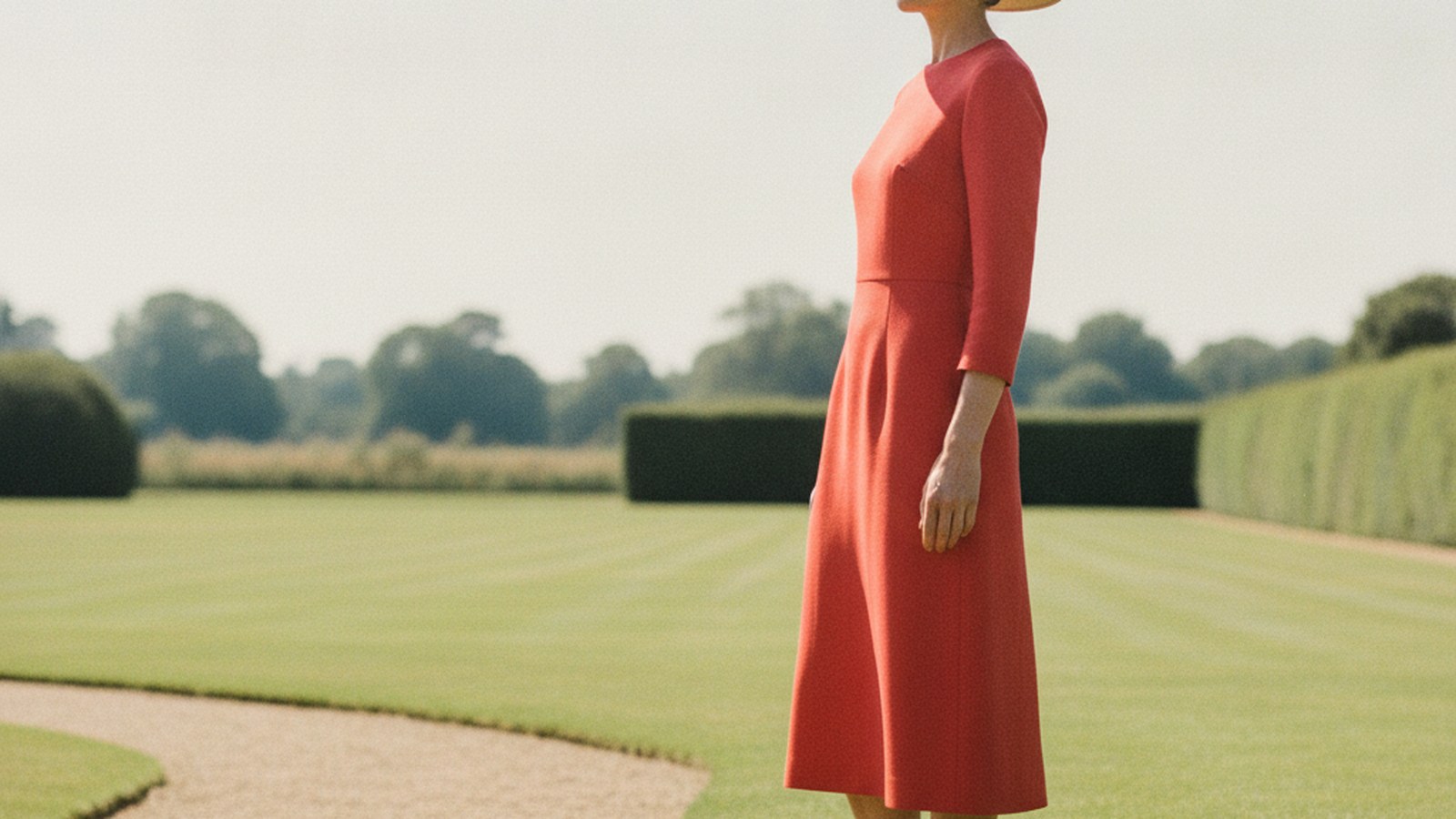
For 2026, creative director Daniel Fletcher has curated The Art of Dressing Well handbook and introduced Royal Ascot’s first Colour of the Year, a bold shade named Bright Tomato. The shade featured prominently at Chanel, Celine, Proenza Schouler, Loewe and Stella McCartney for spring/summer 2026, which means a Bright Tomato piece has rotation value well beyond one Thursday in Berkshire. Racegoers are particularly encouraged to wear the colour on Gold Cup Day, which falls on Thursday 18 June 2026.
The formula:
- A drop-waist midi in Bright Tomato or a tonal coral (Reiss is the easiest place to find a clean, occasion-weight version; their crepe holds shape but moves).
- A silk camisole or a fine knit with one-inch-plus straps, ending exactly at your natural waist. Partial front tuck.
- A cropped blazer in cream or ivory, ending at the natural waist, sleeves pushed if it’s warm.
- A structured hat (Royal Enclosure) or sculptural fascinator (Queen Anne Enclosure). A block heel rather than a stiletto, because Ascot involves significant walking on grass and gravel; elegance and practicality are not mutually exclusive here.
- A small structured bag, top handle. Nothing slouchy.
If Bright Tomato terrifies you, the same formula in ivory, butter yellow or a deep cornflower reads as quietly current rather than ostentatiously on-trend.
The London Saturday formula
Same silhouette, opposite mood. The pieces:
- An Arket or COS drop-waist midi in black, ecru or washed denim. The architectural cut works here because the rest of the outfit goes soft.
- A fine-gauge merino or cotton knit, half-sleeve or short-sleeve, hem ending at the natural waist, partial front tuck at the centre only.
- White leather trainers (low profile, not chunky) or pointed-toe ballet flats.
- A canvas or soft leather tote, worn on the shoulder.
- A trench or denim shirt knotted at the waist if the British summer does what it always does.
The same skim-not-grip thinking applies. The mistake is throwing a boxy overshirt or an oversized sweatshirt over the top and erasing the silhouette entirely. The drop-waist is the point. Don’t hide it.
The celebrity reference, used correctly
Daisy Edgar-Jones has worn the low-yoke skirt silhouette repeatedly this spring, almost always in a fluid fabric with a fitted top ending at the natural waist. It’s the cleanest possible reference for how this works in real British weather: not styled to within an inch of its life, just the right hem on the right top.
One action to take this week
Do the finger-width test in the mirror tonight. Then go to the M&S, Reiss or Arket sites with that number in your head and filter for a drop-waist in crepe or viscose, not poplin. If you’re shopping for Ascot, set a £150 to £250 budget at Reiss and look at Bright Tomato or coral; if you’re shopping for Saturdays, look at Arket or COS in black or ecru. The skirt is the easy part. Getting the top hem right is the styling.