
Twenty-six pairs of hands. Four thousand hours, minimum. Months of stitching in County Monaghan before a single garment hit the Paris runway. Michael Stewart’s debut couture collection for Standing Ground closed Paris Haute Couture Week AW26 with a finale dress that required the entire Carrickmacross Lace Co-op, and it wasn’t even shown in Paris proper. It was staged at the Irish Embassy, a quiet declaration that couture’s most labour-intensive moment this season happened outside the French establishment, tethered instead to a needle-lace tradition most Londoners have scrolled past without knowing its name.
This is the inverse of fashion’s current lace narrative. While Zara pivots hard into sheer lace camis and Reformation churns out prairie blouses, Stewart, a Fashion East alumnus from County Clare, spent 18 months building a collection that makes fast fashion’s ‘lace trend’ look like a category error. The 26 lacemakers weren’t a PR line. They were the literal headcount of women required to execute Carrickmacross appliqué at couture grade, coordinated by creative consultant Natalie B. Coleman, who became the connective tissue between Stewart’s London studio and the Irish makers. Kristen McMenamy closed the show in a gown that embodied the gap: human hours versus algorithmic speed.
Inside Standing Ground’s 26-lacemaker Carrickmacross operation
Carrickmacross lace is not bobbin lace. It’s not Chantilly, not Guipure, not Leavers machine lace. It’s an Irish needle-lace technique in which fine fabric motifs, often floral, always intricate, are appliquéd by hand onto hexagonal net, then embellished with needlepoint fillings and buttonhole-stitch edges. The process is glacially slow. Each lacemaker works a section; the sections are invisibly joined; the garment emerges only after collective labour that can’t be outsourced to a laser cutter or digitised into a CAD file. Stewart’s collection required the full roster of the Carrickmacross Lace Co-op, a County Monaghan collective that has kept the craft commercially alive when most European lace centres converted to mechanisation or collapsed entirely.
Natalie B. Coleman brokered the collaboration, translating Stewart’s couture sketches into stitch maps the co-op could execute without losing the design’s architectural intent. The timeline was punishing: months of pre-production before fittings even began, with each piece requiring multiple lacemakers working in relay. The finale dress alone, the one McMenamy wore, demanded an estimated 600+ hours of appliqué work, not counting the net preparation or the underlining construction. For context, a Zara lace cami is cut, sewn, and shipped in under 48 hours. Stewart’s dress took longer to make than some brands take to conceive, produce, and sell an entire seasonal capsule.
The Irish Embassy venue wasn’t cosplay. Stewart is from County Clare; the lace is from Monaghan; the collection is a genuinely London-Irish production that bypassed Paris’s traditional ateliers in favour of a supply chain rooted in craft infrastructure the French industry long ago abandoned. Alexander McQueen, Fendi, YSL, and Stella McCartney have all featured lace on recent runways, but none disclosed labour rosters. Standing Ground did, and in doing so, turned a Paris couture moment into a referendum on what ‘luxury’ labour actually costs when it’s made visible.
Why couture lace and high-street lace are now sworn enemies
There are two lace trends in British fashion right now, and they despise each other. The first is the Zara-DÔEN-Reformation axis: machine-made, trend-cycle lace that swaps sequins for sheer overlays, priced under £80, designed to rotate through Instagram aesthetics every six weeks. The second is the Standing Ground-Chloé couture axis: hand-executed, months-long, impossible-to-scale lace that costs more per square inch than most people earn per day. Both are called ‘lace.’ Both are trending. But they represent opposing philosophies of what fashion is allowed to be.
The high street accelerated. Retailers report rising demand for lace separates, camis, slip skirts, boho blouses, that algorithmically mimic couture’s romantic return without the labour overhead. The supply chain is frictionless: order lace yardage from a Calais mill or a Chinese converter, cut it on automated tables, ship it to Stratford Westfield within a fortnight. It works because consumers have been trained to read ‘lace’ as a surface signal, not a craft taxonomy. A Honiton bobbin lace and a polyester burn-out lace look similar enough on a phone screen that the difference, 200 years of technique versus 200 seconds of laser etching, collapses into irrelevance.
Stewart’s 26-lacemaker disclosure exposes the gap. Couture lace is decelerating by design: it takes longer, costs more, employs fewer people more intensely, and produces garments that can’t be reproduced at scale. It’s the opposite of democratic fashion, and it doesn’t apologise. The Carrickmacross Co-op can’t expand to meet demand; there aren’t enough trained hands. The Lace Guild in Stourbridge teaches Honiton lace, but apprenticeships take years, and commercial viability is fragile. What Standing Ground proved in Paris is that couture lace and high-street lace are no longer part of the same trend cycle, they’re parallel systems that happen to share a vocabulary but have entirely different metabolisms.
How to actually spot Carrickmacross lace on your next scroll
Start with the net. Carrickmacross is always appliquéd onto a visible mesh ground, usually a fine hexagonal or square net that you can see between the motifs. If the lace looks like a solid fabric with holes punched through (that’s Guipure or laser-cut), it’s not Carrickmacross. If it’s a continuous web of thread with no net backing (that’s bobbin lace or needlepoint), it’s not Carrickmacross. The net is structural, not decorative. It holds the appliquéd motifs in place and gives the lace its translucent, floating quality.
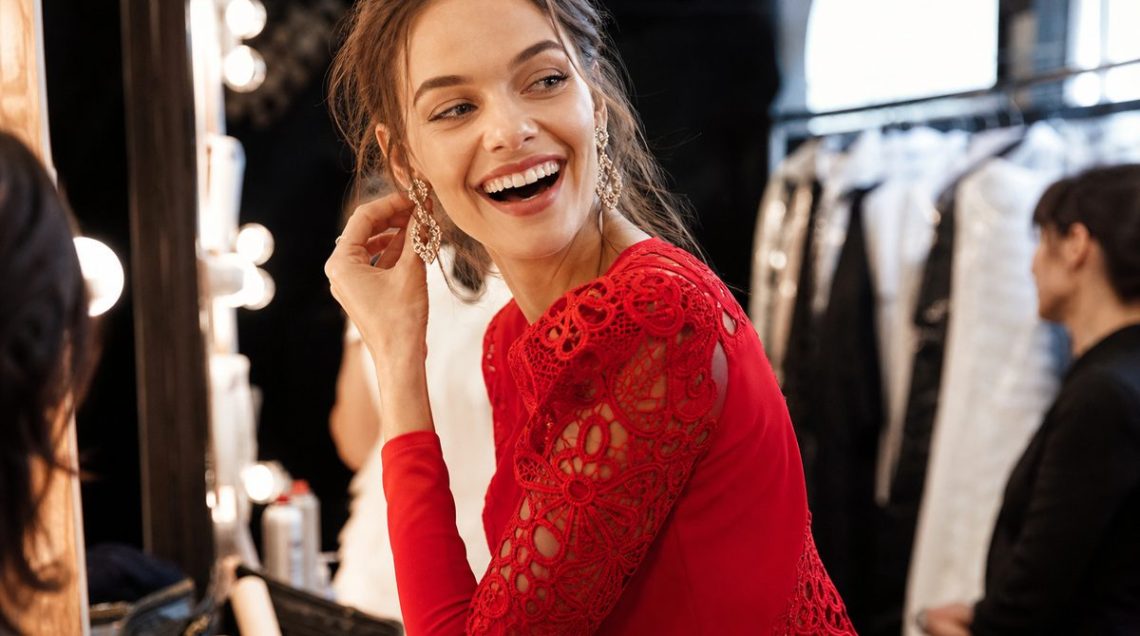
Look for irregularity in the motifs. Machine lace repeats perfectly; hand lace doesn’t. Carrickmacross motifs, typically floral, occasionally geometric, will show micro-variations in tension, stitch density, and edge finishing if you zoom in on editorial images. The appliqué edges are finished with buttonhole stitch (a dense, looped edge that looks slightly raised), and the motifs often include needlepoint fillings (tiny decorative stitches inside the shapes) that vary slightly from one section to the next. If every flower looks identical down to the thread count, it’s machine-made.
Check the context. Alexa Chung and Adwoa Aboah have both been photographed in vintage or contemporary lace pieces that read as Carrickmacross or Honiton, usually styled with denim or minimal tailoring to let the lace register as craft, not costume. Zoë Kravitz recently wore a lace overlay piece that sparked speculation about its origins (unconfirmed, but the appliqué structure suggested hand work). When you see lace on a UK street-style account or a Chloé runway, ask: does this look like it took 26 people, or does it look like it took 26 minutes? The answer tells you which lace economy you’re looking at, and whether the trend you’re seeing is about speed or about survival.