By Alina, Fashion & Style Writer. Alina is a fashion and style writer at Mūsmūs, where she covers everyday styling, trends and wardrobe-building. She writes for women who want clarity over hype, practical outfit logic they can actually use.
If your linen blazer keeps reading like office armour, the fix is rarely the styling, it is the blazer itself plus one structural rule: keep it as the only tailored thing in the outfit. A soft, unstructured single-breasted linen blazer over a faded tee and wide-leg trousers will always look more like Saturday than Monday. A stiff, peak-lapel, double-breasted one will fight you no matter what you put underneath.
Below is the logic, then the outfits. Both matter, because most styling advice skips the first part and wonders why the second never quite lands.
Why your linen blazer reads formal (it is the blazer, not you)
Three design details are doing the heavy lifting toward boardroom: full canvas or stiff interlining, peak lapels, and double-breasted closure. Any one of those will pull the eye toward suiting. Two of them together, and no amount of white tee and trainers will rescue it.
For casual summer wear, the cuts that actually behave themselves are unstructured single-breasted notch lapels (think Madewell, Reformation, The Frankie Shop), or, better still, collarless and Mandarin-collar styles (The Row, Toteme, COS). A collarless linen blazer is the stealth move of the category: your eye reads it as a jacket rather than a blazer, which bypasses the office association entirely.
Fabric weight matters just as much. Light linen, under roughly 150gsm, drapes and creases like a worn-in shirt. Medium-weight linen at 180 to 200gsm holds its shape and reads more formal because it stands away from the body. If the blazer feels stiff and heavy off the hanger, it will behave that way on you. Shop for soft, drapey linen that moves. Linen-lyocell blends are worth considering too: they wrinkle less aggressively and breathe well, without going full crease-proof (which always looks synthetic).
The one structured thing rule
This is the formula that makes casual blazer outfits actually work. When the linen blazer is the only tailored item in the look, everything else can be completely soft: a slip dress, a ribbed tank, washed denim, a worn cotton tee, bare legs, flat sandals. The blazer does all the structural and occasion signalling, which frees the rest of the outfit to be as relaxed as you want it.
The moment you add a second tailored piece (a pressed trouser in the same fabric, a stiff button-down, a polished leather mule), the look tips into suiting. That is where the interview feeling comes from. Not the blazer alone, but the accumulation of structure.
Stop ironing it flat
A crisply pressed linen blazer reads formal. A slightly worn-in, naturally creased one reads weekend. The wrinkles are not the problem, they are the styling tool. Hang it up after wearing, smooth the lapels with your hand, and let the rest of the fabric live its life. If you steam, do it lightly and only on the shoulders and collar. The texture is the whole point of choosing linen over wool in the first place.
Four outfit formulas that actually work
1. Linen blazer + slip dress + flat sandal
A bias-cut satin or washed-silk slip dress in ivory, black or a muted print, with a soft single-breasted linen blazer thrown over the top, and a flat leather sandal or fisherman sandal. This is the cleanest expression of the one-structured-thing rule. The dress is pure ease, the blazer carries all the polish, the flat shoe refuses to take it anywhere near corporate. Add a raffia or straw bag for texture contrast against the blazer’s clean line.
2. Linen blazer + ribbed tank + wide-leg linen trousers
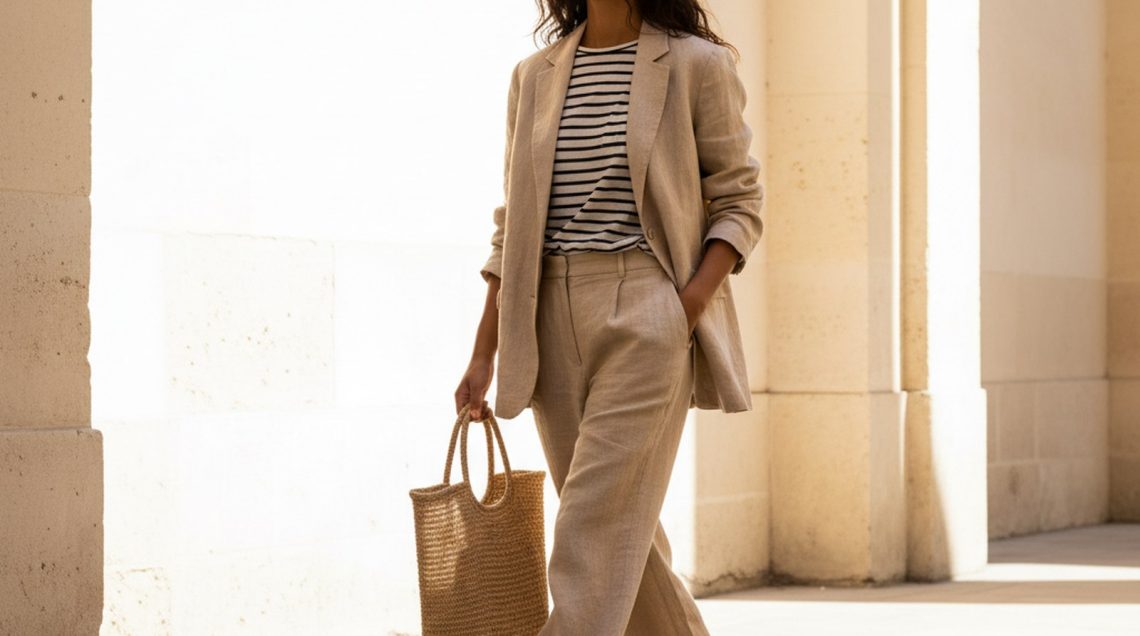
Best in collarless form. A ribbed cotton tank (white, black, or chocolate), wide-leg linen trousers in a tonal but not identical shade to the blazer, and a flat leather sandal or a low loafer. The trick: do not match the blazer and trousers exactly. Tonal yes, identical no, otherwise you are wearing a suit. A half-tuck on the tank, sleeves pushed once, no jewellery beyond a slim gold hoop.
3. Linen blazer + cotton shorts + faded tee
This is where most people go wrong by reaching for tailored shorts in the same linen as the blazer. Do the opposite. The shorts should be in a softer, more casual fabric than the blazer: washed cotton, terry, crinkle cotton, even a satin boxer short for evening. A faded striped or solid tee underneath, a fisherman sandal or a worn-in white trainer on the foot. The contrast in fabric register is what stops it from reading like a summer suit attempt.
Want more of this kind of styling logic, the reasoning behind the outfit rather than just the outfit? My weekly note from Mūsmūs lands every Sunday with one wardrobe formula, one fabric or fit rule worth knowing, and a small edit of pieces I would actually buy. No noise, no affiliate dumps. Sign up at the foot of the page.
4. Linen blazer + bike shorts + tank
The most underestimated of the four. A long, slightly oversized linen blazer (collarless or notch lapel, single-breasted) over black bike shorts and a fitted ribbed tank, with a flat leather sandal or a low fisherman. The proportional logic: the blazer’s length covers the shortest part of the leg, the shorts disappear, and the whole look reads as one long line broken only by the tank. Works for school run, errands, dinner outside in August heat.
The shoulder seam rule no one explains
Even an oversized linen blazer must sit at, or very close to, your natural shoulder. If the seam drops halfway down your upper arm, the blazer looks borrowed rather than chosen. This is the single fit point that separates an intentional Toteme- or Row-style oversized cut from looking like you have raided someone else’s wardrobe. Size up for room through the body if you want that relaxed line, but check the shoulder first, every time. A drooping shoulder cannot be styled around.
The footwear hierarchy, from most to least casual
Each step up the ladder formalises the outfit by roughly one register: fisherman sandals (most relaxed), flat leather sandals, mesh ballet flats, loafers, white trainers, heeled sandals (most polished). If you are aiming for genuinely casual, stay in the first three. White trainers are not the casual saviour they are sold as, with a linen blazer they often tip the look into off-duty corporate, which is its own particular flavour of trying too hard.
One thing to do this week
Take your linen blazer off the hanger and check the three things that matter: the lapel style, whether it is lined or unstructured, and how the fabric feels in your hand. If it is soft, single-breasted and either notch or collarless, you have a casual anchor piece. Build around it with one soft fabric, one bare or near-bare leg, and one textural accessory (raffia, terry, woven leather). If it is stiff and peak-lapelled, save it for the wedding and buy a second, softer one for the rest of summer. They are doing different jobs.