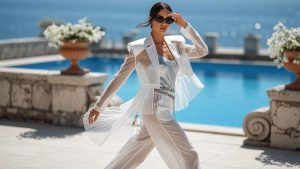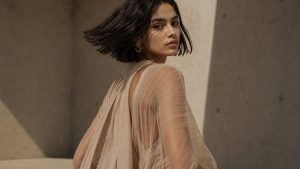
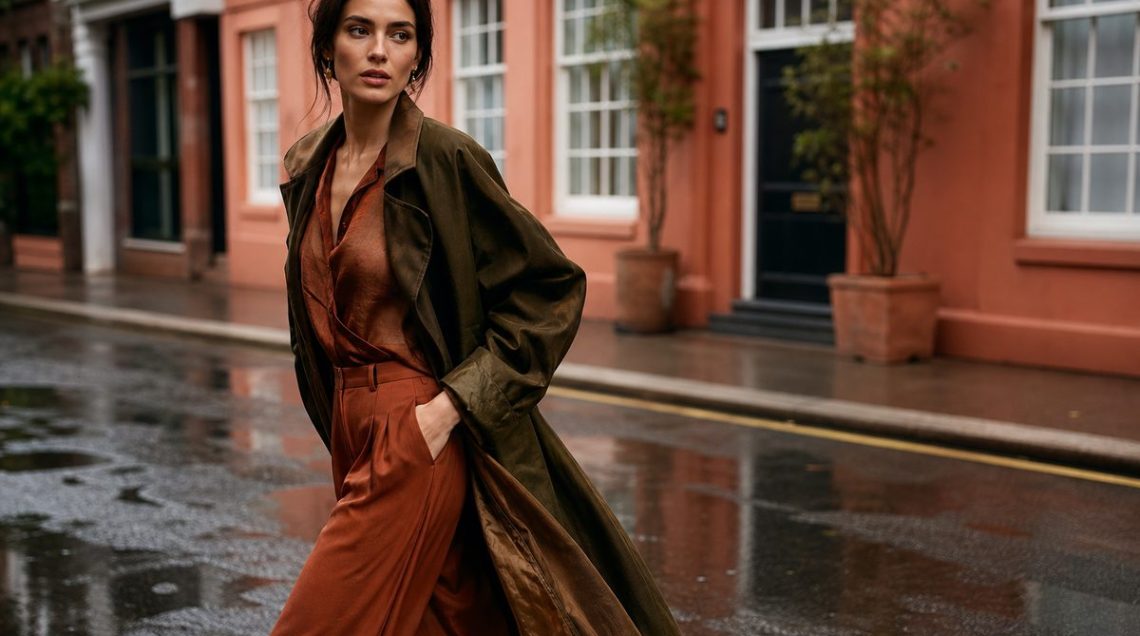
We are caught, this August, in a curious sartorial impasse. The trouser that dominated every summer wardrobe from 2023 onwards, the crisp, crumpled linen wide-leg, sold by everyone from Zara to & Other Stories, has quietly disappeared from the pavement. In its place: a trouser altogether more demanding, more glossy, more intentional. The taffeta trouser, in cobalt blue or electric pink, has become the signal of a deeper shift in how Britain wants to be seen.
This is not simply a matter of fabric fatigue, though linen fatigue is real and documented. It is a question of mood, of volume, of the return to dressing that announces rather than apologises. The taffeta trouser, stiff, sculptural, often ballooning at the thigh, represents a swing back toward what the industry calls ‘intentional dressing’, a rejection of the effortless naturalism that has governed British style since the lockdown era. And we believe the debate itself reveals more about our present moment than either trouser ever could.
The taffeta trouser has quietly buried the linen wide-leg
The evidence is everywhere, if you know where to look. Runway archives from Prada and Alaïa have featured silk taffeta balloon trousers since Spring 2025, but it is only now, mid-2026, that the high street has caught up. Reformation, Mango, COS, H&M, and ARKET have all introduced versions in dupioni silk or polyester techno taffeta, each with the signature drawstring waist and wide-leg silhouette that defines the category. The linen trouser, by contrast, has been relegated to sale rails and archive edits.
What the Instagram post above captures, stylist-approved pairings of taffeta trousers with minimal knits and flat sandals, is the vocabulary of a new proportion rule. The taffeta trouser does not drape; it holds its shape, reflecting light in a way that linen never could. This structural difference is not cosmetic. It changes how the body is read, how volume is distributed, and how the trouser interacts with the rest of the outfit. Where linen softened and blurred, taffeta sharpens and announces.
The SemiSustainable Substack, in a publicly available analysis earlier this year, connected the viral rise of colourful taffeta trousers to a broader pendulum swing toward maximalism amid 2026’s economic uncertainty. In a UK context, where cost-of-living pressures have not abated, dressing for visibility, for joy, for defiance, makes cultural sense. The taffeta trouser is not subtle. It does not apologise. It is, in that sense, the perfect garment for a year when quiet luxury has begun to feel quietly exhausted.
Why ‘intentional dressing’ is winning the 2026 mood war
Intentional dressing is not new, but its resurgence in 2026 marks a clean break from the aesthetic that preceded it. For three years, British wardrobes were governed by a doctrine of ease: linen, cashmere, ecru, the studied nonchalance of a Khaite knit or a Donni co-ord. That era, we now see, was a response to the trauma of confinement, a retreat into softness and simplicity. But softness, it turns out, has a shelf life.
The taffeta trouser, and the wider trend it represents, demands preparation, consideration, even performance. It cannot be thrown on. It requires a slim or tucked-in top, a low or flat shoe (kitten heel or flip-flop, as noted by Who What Wear stylists), and an understanding of how volume at the hip and thigh must be countered by restraint elsewhere. This is dressing that announces intention, that refuses to disappear into the background. And in a year defined by political turbulence, climate anxiety, and economic precarity, the desire to be seen, to be present, to claim space, feels both urgent and logical.
Runway styling data from Prada, Alaïa, and Khaite supports this reading. The taffeta trouser is almost never paired with loose or voluminous tops; it is almost always anchored by a fitted knit, a cropped jacket, or a simple tank. The proportion rule is strict because the trouser itself is unforgiving. This is not effortless dressing. It is dressing that requires effort, and that effort is the point.
The proportion rule and colour hierarchy every UK wardrobe now needs
If you are going to wear a taffeta trouser, you must understand its geometry. The rule, synthesised from runway styling across Prada, Alaïa, and high-street interpretations, is this: stiff volume at the hip and thigh demands a slim or tucked-in silhouette above, and a low or flat shoe below. A ballet flat, a kitten heel, a leather flip-flop, all work. A chunky trainer or platform boot does not. The taffeta trouser creates its own centre of gravity; your job is not to compete with it.
Colour, too, follows a hierarchy. Pink taffeta has dominated Instagram and editorial coverage, but cobalt blue, electric green, champagne, and dark olive are the shades gaining traction for autumn. Cobalt works for evening and cooler-toned complexions; electric green reads as playful and youthful; champagne bridges day and night; dark olive, quietly, is the most versatile. According to sources including The Zoe Report and Who What Wear, retailers are reporting rising demand for these deeper, more saturated colourways as we move beyond summer.
The distinction between silk taffeta, dupioni silk, and polyester techno taffeta matters more than most outlets acknowledge. Silk taffeta is the lightest and most fluid, with a crisp hand and subtle sheen. Dupioni silk has more texture, a slubbed surface that catches light unevenly. Polyester techno taffeta is the stiffest and most architectural, holding shape with almost sculptural rigidity. Each reads differently on the body, and each demands a different approach to proportion and styling. The gap between them is not academic, it is the difference between a trouser that moves with you and one that holds its ground.
What remains to be seen is whether the taffeta trouser will survive beyond this season, or whether it will join linen in the archive of exhausted trends. But for now, it is the garment that best articulates the mood of 2026: bold, intentional, refusing to blend in. And in that refusal, it tells us something about how Britain wants to dress now, not with ease, but with purpose.