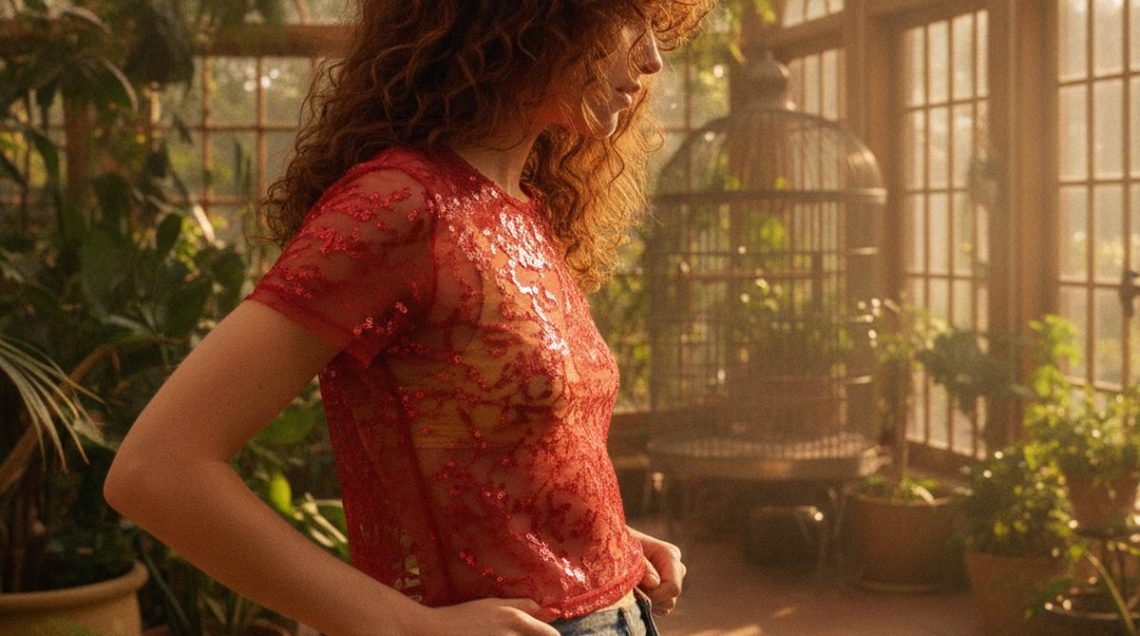

Lily Allen has just done what every British millennial secretly feared: she’s brought back the ultra-low-rise trouser. Stepping out in Los Angeles wearing a Marc Jacobs crop top paired with jeans that sit so low they’re practically defying gravity, the singer-turned-podcaster has reignited a debate the UK fashion world thought it had permanently settled in 2008.
The look, captured by street style photographers and immediately dissected across social media, isn’t just another celebrity outfit moment. It’s a cultural flashpoint that’s forcing Britain to reckon with its complicated relationship to Y2K maximalism, body politics, and the cyclical nature of trend resurrection.
Why Lily Allen’s Marc Jacobs crop top moment matters
Lily Allen has always possessed an uncanny ability to embody the contradictions of British style. From her Chanel trainers and prom dresses era to her current incarnation as a transatlantic tastemaker, she’s never played it safe. This Marc Jacobs moment reads as deliberate provocation—a calculated nod to the early noughties when she first emerged as pop’s irreverent darling.
The crop top itself is quintessential Marc Jacobs: structured, slightly subversive, with that particular American sportswear sensibility that British brands could never quite replicate. Paired with jeans that showcase a hip-to-waist ratio the 2010s spent a decade rejecting, it’s a masterclass in fashion revisionism.
What makes this significant isn’t just the garments—it’s the timing. Britain’s current fashion climate oscillates wildly between Quiet Luxury minimalism and Indie Sleaze nostalgia. Lily Allen has planted her flag firmly in neither camp, instead excavating something deeper: the unfiltered, unapologetic body consciousness of the Tumblr generation’s childhood.
The 00s trend Britain swore it had buried for good
Ultra-low-rise denim occupies a uniquely traumatic place in British fashion memory. It wasn’t just a trouser cut—it was an entire ecosystem of body anxiety, visible G-strings, and the tyranny of what Grazia once called “the muffin top epidemic.” When high-waisted everything returned around 2014, the collective sigh of relief was audible from Shoreditch to Manchester.
Yet here’s the uncomfortable truth the industry must now confront: Gen Z never experienced low-rise the first time round. To them, it’s not a trigger—it’s an aesthetic curiosity, a vintage silhouette as distant as Dior’s New Look. TikTok teenagers are raiding Depop for Juicy Couture velour and early True Religion, completely divorced from the original context.
The British resistance to this trend runs deeper than mere aesthetics. It’s tangled up with class signifiers, regional identity, and our particular brand of body image discourse. Low-rise was simultaneously aspirational (Size Zero celebrity culture) and chavvy (market stall knock-offs), a contradiction that made it uniquely loaded in the UK cultural landscape.
How to wear the revived 00s look without looking costume
If you’re tempted to experiment with the low-rise resurgence, the key lies in strategic selectivity rather than wholesale recreation. Pair vintage Levi’s 501s worn deliberately low with a contemporary structured blazer—think Toteme or The Frankie Shop—to ground the silhouette in present-day proportions.
The crop top element requires equal calibration. Avoid the cropped band tees of 2004 in favour of architectural knits or tailored pieces that create negative space rather than simply exposing skin. Marc Jacobs understands this instinctively; his current collection treats the midriff as a design element, not an inevitability.
British high street retailers are already responding. Zara’s latest drop features subtly lowered waistbands, while & Other Stories has introduced what they’re diplomatically calling “mid-low rise” denim. The translation is clear: the trend is arriving whether we’re ready or not. The question isn’t if low-rise will dominate 2025, but how Britain will negotiate its return on our own terms.