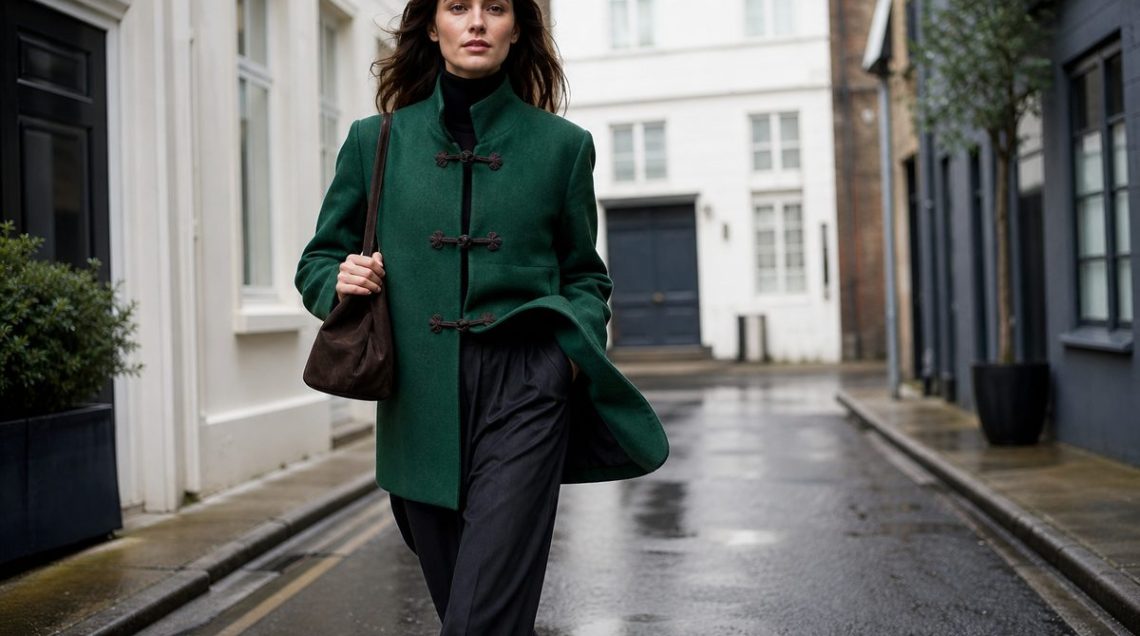
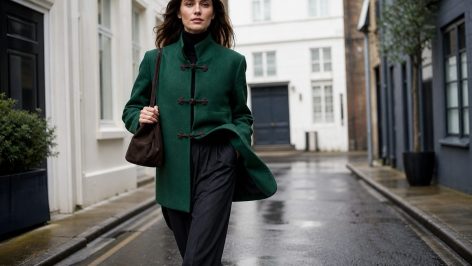
While every other editor defaults to the trench this September, autumn’s first major buy is quietly polarising the fashion desk: the frog-fastening jacket. Róhe’s viral Pankou jacket kicked off the conversation, but what started as a single viral moment has crystallised into the season’s most culturally coherent statement piece, and the anti-trench of AW26.
The timing is no accident. After a summer dominated by pared-back quiet luxury, the frog-fastening jacket offers precisely calibrated maximalism: decorative without being loud, heritage without being costume. It’s the jacket that does all the talking, so the rest of your outfit can stay tonal and unfussy.
Why the frog-fastening jacket is autumn’s first major statement
The frog fastening, also called pankou or Brandenburg closure, is the detail that separates this season’s outerwear from every other wool blazer on the rail. Treat it like statement jewellery: the rest of the outfit should be pared back, no competing hardware, so the closure does all the work. That’s the stylist’s rule, and it’s why the jacket reads as editorial rather than fancy dress.
Proportionally, the silhouette is forgiving if you buy with intention. For petite frames, opt for a cropped version that hits at the hip; for taller frames, the longer mandarin-collar coat version elongates without overwhelming. The key is ensuring the toggles sit flat against the body, if they gape or pull, size up.
Zara has already rolled out high-street frog-fastening styles for AW26, alongside & Other Stories, M&S, ASOS, COS, and Arket, all offering accessible alternatives to Róhe’s originating moment. The breadth of retail backing confirms this isn’t a flash trend; it’s a buy with legs.
From Róhe to Bora Aksu: the AW26 craft heritage backing this trend
The frog fastening has roots in Chinese, Ottoman, and 18th-century European military dress, the same historicism that ran through AW26 LFW. Bora Aksu’s 1700s references, Erdem’s heritage silhouettes and high ruffled necklines, Simone Rocha’s ornamental ribbon details, all feed the same narrative of decorative closures and tactile craft.
Daniel Lee’s Burberry AW26 trench was the expected alternative this season, but the frog-fastening jacket is the more original pivot. It’s the contrarian buy for anyone tired of trench redux, yet still rooted in the season’s broader codes: identity tailoring (Tolu Coker), tactile detail (Traiceline Pratt and Goyagoma at Fashion East), and millinery-level accessories focus (Stephen Jones). The jacket sits at the intersection of all three.
Even Heuritech’s trend forecast data on raw denim and dome bags for AW26 supports the wider shift toward craft-forward, historically grounded pieces. The frog-fastening jacket is the outerwear expression of that movement, decorative, yes, but deeply intentional.
How to buy one that actually lasts (and what to avoid)
Fabric matters more here than with most jackets. Wool-blend and boucle versions hold the toggle construction better and look exponentially more expensive; the loops keep their shape through repeated wear. Avoid polyester satin versions entirely, the fabric stretches, the loops lose tension, and the whole piece reads cheap within a fortnight.
Check the stitching around each toggle before you buy. If the thread is loose or the loop feels flimsy under gentle pressure, walk away. The fastening is the jacket’s entire point; if it fails, you’re left with an oddly detailed blazer that doesn’t justify the investment.
Pair with tonal trousers, minimal footwear, and zero additional hardware, no statement bag, no layered necklaces, no belt with visible hardware. The frog fastening is your only decorative moment. If you’re tempted to add more, you’ve misunderstood the assignment. And if you’re still undecided between this and the trench, ask yourself: do you want to look like everyone else this autumn, or do you want to be the room’s most interesting silhouette?