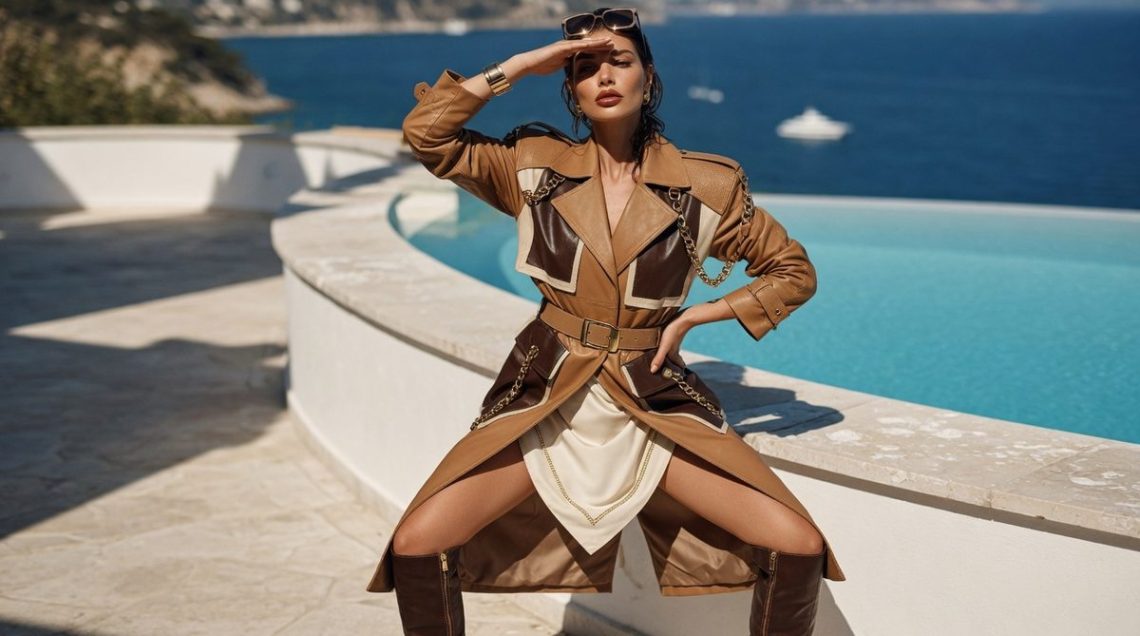
R&M Leathers landed on the London Fashion Week schedule this season with a debut that made front-row editors do a double take: the show was funded by Pornhub. The London-based leather label, founded by designer Ruby Mariani, staged its collection inside the Round Chapel in Clapton, with set design from Patience Harding, and the sponsorship line alone was enough to dominate UK fashion chatter within hours.
The story has travelled fast because it sits at an uncomfortable junction of British fashion history, subcultural politics and the platform economics of 2026. A fetish-adjacent label backed by an adult platform is showing during the same week Ofcom’s age verification rules are reshaping who can even access that platform in the UK, and that tension, more than the leather itself, is what’s driving the search spike.
Inside R&M Leathers’ Round Chapel debut, minute by minute
The venue set the tone before a single look came down the space: a deconsecrated Victorian chapel in Clapton, its vaulted ceiling and stained glass repurposed as a backdrop for latex and harnessed leather. Patience Harding’s set design leaned into that sacred-profane contrast rather than smoothing it over, and R&M Leathers used the room to stage its clothes as ritual objects rather than product.
Ruby Mariani’s designs draw an explicit lineage back to John Sutcliffe and his 1960s label AtomAge, the British rubber and fetishwear photographer-designer whose catalogues quietly shaped decades of London’s kink aesthetic long before it reached a runway. That’s a real subcultural throughline, not a costume reference, R&M Leathers’ harnesses and moulded leather pieces sit in a specifically British tradition, the same one that has previously dressed Charli XCX, Addison Rae, Miley Cyrus and Olivia Rodrigo for red carpets and music videos.
Vogue Runway’s own framing of the show, funded debut, scaling ambitions, immediately asks the question the label itself can’t fully answer: whether a subculture built on niche craft and specific codes can survive being underwritten by one of the biggest adult platforms in the world without losing what made it legible as subculture in the first place.
Sex sold for Calvin Klein, but Pornhub is buying reach now
The historical comparison practically writes itself: Calvin Klein’s 1990s campaigns, Tom Ford-era Gucci, American Apparel’s early-2000s ad strategy. Those brands used explicit imagery to sell clothes directly to a mass audience that had no other way to see it. Pornhub funding a London Fashion Week show in 2026 is a different transaction entirely, because the audience it’s buying isn’t a shopper, it’s a screenshot.
The irony sharpens considerably once you factor in what’s happening to Pornhub’s UK access. Under the Online Safety Act, Ofcom’s age verification requirements have pushed Aylo, Pornhub’s parent company, toward blocking unverified UK users from the site from 2 February 2026 onward, according to reporting from outlets including Euronews and CNBC. A platform being pushed out of directly reaching UK visitors is simultaneously paying to be seen at one of the UK’s most photographed fashion events. That reads less like proof that sex still sells and more like reputation laundering through culture, buying goodwill and relevance in a market it can no longer freely operate in.
It’s also worth checking the track record of brands that have taken Pornhub sponsorship money before assuming this playbook pays off commercially. Shayne Oliver’s Hood By Air did a Pornhub tie-in back in 2017 and the label has spent years since in and out of collapse and relaunch attempts. Ludovic de Saint Sernin’s 2022 Pornhub-backed BDSM ballet collection, worn memorably by Miley Cyrus, generated plenty of imagery without visibly changing the brand’s commercial scale. Vaquera followed with its own Pornhub collaboration in 2024. None of those precedents amount to a clean case study in provocation converting to sales, what they consistently deliver is coverage, not revenue.
How to read fashion’s kink revival without buying the hype
R&M Leathers isn’t showing in isolation. This London Fashion Week season sits inside a wider kink-adjacent runway moment that’s taken in Rick Owens, Dilara Findikoglu, Alexander McQueen and Alessandro Michele’s Valentino, all leaning on bondage-coded silhouettes, harnessing and fetish-wear detailing well before R&M’s funding story broke. The vocabulary is shared across the industry right now: constraint, exposure, hardware as ornament, not something R&M invented, but something it’s currently the most talked-about example of.
There’s a genuine tension worth sitting with here, one Mariani herself has raised in interviews with Dazed and Nylon: brands repeatedly borrowing fetish and BDSM codes while flattening or misrepresenting the subculture they come from. A designer who has voiced that frustration now fronting a platform-funded show doesn’t resolve the contradiction, it just puts it on a runway.
The useful read for anyone scrolling past this story on Discover is to separate reach from revenue. Provocation in 2026 functions as a distribution tactic, screenshots, quote-tweets, algorithmic bait, rather than the direct sales lever it was for Calvin Klein or American Apparel in a pre-social, pre-free-porn media landscape. Retailers report rising interest in fetish-adjacent leather pieces this season, but interest and a receipt are not the same thing. Whether R&M Leathers converts its Round Chapel moment into an actual business, or joins the list of labels that got the headlines and not much else, is the part nobody in London Fashion Week’s front row can answer yet.