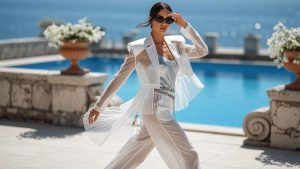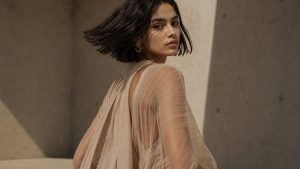
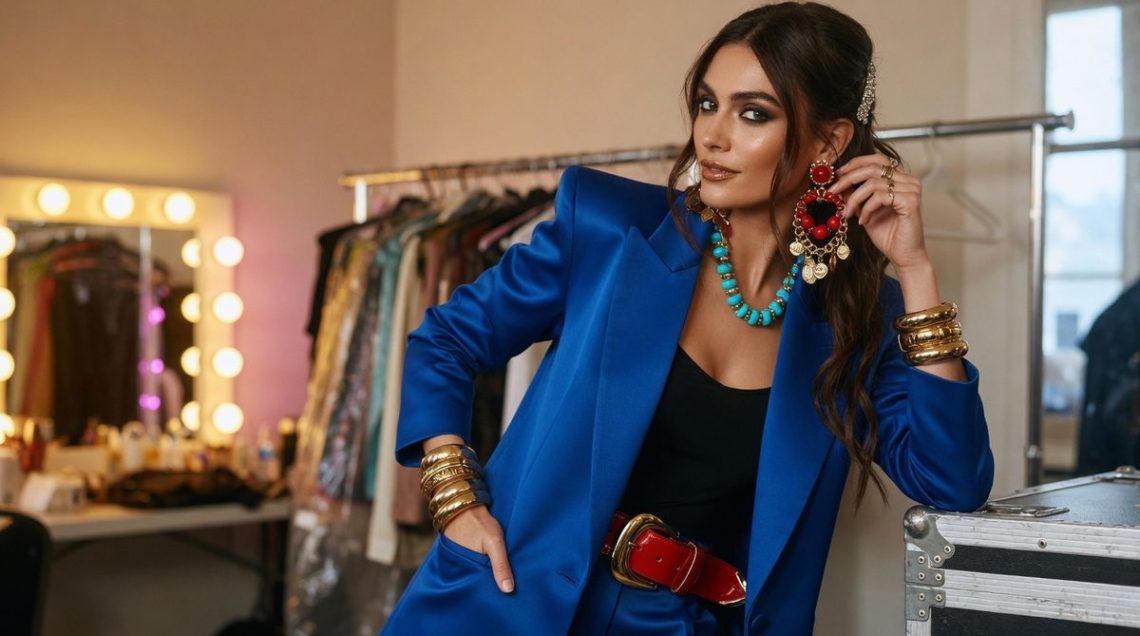
Something fundamental has shifted on the streets of London, Milan, and Paris. After years of quiet luxury and clean-girl minimalism, where the absence of accessories signalled status, fashion people are accessorising with the kind of chaotic abundance last seen in 2006. Scarves are wrapped around handbag straps, brooches are clustered across lapels, and ties are worn by women who’ve never set foot in a boardroom. This isn’t a gentle pendulum swing; it’s a wholesale rejection of the restraint that defined the previous cycle.
The timing is precise. Google Trends UK data confirms that searches for “fashion people are accessorising” have surged in recent weeks, driven by runway reports from SS25 and AW25 collections, street-style coverage from fashion weeks, and a flood of resale activity on Vinted and Depop. Who What Wear UK and Marie Claire UK have both published extensive accessory trend reports for the season, signalling that this is no longer niche styling, it’s the dominant visual language of 2026.
The signal: why fashion people are accessorising everything, everywhere
The clearest evidence of this shift sits in the details. At Bottega Veneta’s SS25 show, models wore tasselled caps and knitted flowers, not as statement pieces, but as layered elements within a larger vocabulary of ornament. Saint Laurent sent oversized suits down the runway styled with ties worn by women, a direct nod to the Bella Hadid era of borrowed-from-the-boys dressing. Dries Van Noten showed woven corset belts at AW25; Miu Miu presented faux-fur stoles. These aren’t isolated runway moments, they’re part of a coordinated maximalist turn that’s now filtering into street style and editorial coverage.
ASOS editorial recently reported on London Fashion Week street style, highlighting the scarf belt as a defining accessory: a silk square threaded through belt loops, knotted at the hip, transforming a functional garment into a decorative flourish. This is the logic of the current moment, what trend forecasters are beginning to call the “functional-decorative flip”, where utility items are repurposed as ornament and decorative pieces are worn for structure. Crossbody bags, once prized for hands-free practicality, are now styled as statement pieces with bag charms, Labubu keychains, and vintage brooches clipped to straps. Headbands are worn as ear warmers. Belts are worn as necklaces. The boundary between function and decoration has collapsed.
Marie Claire UK’s AW25 accessories report identified brooches as a key revival, tracing the trend directly to Matthieu Blazy’s appointment at Chanel. Blazy’s maximalist jewellery approach, clustering brooches across tailoring, reviving the codes of old couture, has been widely cited as the catalyst for a broader shift away from minimalist jewellery. Celebrity stylist Ellis Ranson, quoted publicly via AOL, confirmed that clients are now requesting brooches for red-carpet styling, a marked departure from the delicate gold chains that dominated 2023-24.
The cultural roots of the maximalist backlash
This accessorising surge is not arbitrary. It’s a direct cultural response to the aesthetic fatigue created by clean-girl minimalism and quiet luxury, two overlapping trends that peaked between 2022 and early 2025. The clean-girl aesthetic, with its bare nails, slicked buns, and absence of visible adornment, signalled a kind of algorithmic perfection that ultimately felt sterile. Quiet luxury, championed by Succession-era tailoring and The Row’s austere elegance, prized the absence of logos and ornament as the ultimate status marker. But absence, as a long-term aesthetic strategy, is unsustainable. It offers no room for play, no space for identity expression, no friction.
The backlash has been building for months. Chemena Kamali’s appointment at Chloé and her immediate revival of boho-chic codes, fringe, embroidery, layered jewellery, signalled that the industry was ready to move. The 20-year nostalgia cycle, long a predictable engine of fashion trends, is now compressing. Y2K aesthetics, rooted in the early 2000s, dominated editorial coverage in 2023-24. But by mid-2025, fashion people had already moved on to 2006 references: the WAG wardrobe era of Victoria Beckham, the Indie Sleaze of Alexa Chung and Kate Moss, the It-girl maximalism of Sienna Miller and the Olsen twins. The Balenciaga City Bag and Chloé Paddington, icons of 2006, are now resurfacing on Depop and Vinted at unprecedented velocity. The cycle, once a 20-year loop, is now running on a 15-year, then 10-year, compression.
This isn’t just nostalgia for nostalgia’s sake. 2006 represents the last moment before the financial crisis, before austerity, before the clean-girl logic of optimised self-presentation. It was an era of abundance, of visible consumption, of accessories worn not for function but for the sheer pleasure of ornament. The return to that visual language is, in part, a rejection of the post-2008 restraint that has defined fashion for nearly two decades.
How to wear the functional-decorative flip now
The key to accessorising in 2026 is understanding the layering logic. This is not about adding one statement piece to an otherwise minimal outfit, it’s about creating texture through accumulation. Start with a base: tailoring, denim, knitwear. Then layer in accessories that serve dual purposes. A silk scarf can be worn as a belt, a necktie, a bag charm, or a headband. A brooch can be clustered with others across a lapel, or used to cinch a cardigan at the waist. Ties, traditionally borrowed-from-the-boys, are now worn loose over blouses, knotted at the collar, or threaded through belt loops.
Marie Claire UK’s SS25 report identified three accessories with staying power across multiple seasons: oversized belts (seen at Dior, Loewe, and Saint Laurent), faux-fur stoles (Miu Miu, Bottega Veneta), and brooches (Chanel, Jonathan Anderson’s runway styling). These pieces have appeared in runway reports for SS25, AW25, and early SS26 previews, suggesting they’re not one-season novelties but part of a longer maximalist cycle. In contrast, tasselled caps and knitted flowers, while visually striking, have appeared only sporadically, suggesting they’re editorial moments rather than wardrobe staples.
The functional-decorative flip also extends to bags. Crossbody styles, once prized for their practicality, are now being customised with bag charms, vintage keychains, and Labubu figures, a chaotic, personalised approach to styling that recalls the early-2000s It-girl habit of clipping trinkets to Balenciaga City Bags. Christian Dior’s AW25 collection featured ruffled collars and lace detailing, signalling that even traditionally decorative elements are being worn as structural components. The line between ornament and utility is no longer fixed.
For those entering this accessorising moment, the longevity framework matters. Invest in pieces that have appeared across multiple seasons and multiple designers, belts, brooches, faux-fur stoles, rather than chasing one-off runway novelties. And remember: the pleasure of this trend lies not in perfection, but in the visible evidence of choice. Layer, clash, customise. The era of restraint is over, and what comes next is still being written in scarves, ties, and brooches pinned to everything that stands still long enough.